
The album starts off with the beautifully composed Mera Rang De Basanti sung by Sonu Nigam and popular Punjabi singer Manmohan Waris. The song carries a lot of Punjabi flavour in it´s composition, but with Rahman´s modern touches it takes on a new life. Rahman sprinkles the track with slight dhol rifts to add that northern touch. His signature flute soothes the listener in the bridges, despite a repressed melancholy feel in the composition. Lyrically the track is patriotic and traditional, generally the lyrics are very well written. Sonu Nigam gives us yet another brilliant rendition. He voice carries a repressed energy which explodes in the song. Manmohan Waris does a great job harmonizing, however in some portions of the track he just barely hits the notes with difficulty, however his rendition is commendable. Up next is Pagdi Sambhal Jatta sung by Sukhwinder Singh. The harmonium in the opening of the song sets a very distinct mood, but as the track progresses it falls apart. The song is catchy no doubt but that doesn´t make it good. For one thing, the composition of the song is very popish and doesn´t go well with the mood or lyrics of the song. The violins and banjo take away from the song and with the chorus chanting ´lak tunu tunu´ you can´t help but feel disappointed. The lyrics are situational and somewhat confrontational but in a playful way. Sukhwinder Singh is in his element in this fast paced track. His rendition really lifts the track mainly due to the way he stretches the words to fit the pace of the song. Rahman composes three versions of Desh Mere Desh. The first is titled Dil Se Niklegi and is sung by Sukhwinder Singh. It´s the soothing melody which immediately grabs your attention. The simplicity of the composition and scarce use of instruments highlight Sukhwinder´s vocals. His soft vocals fit the song perfectly, leaving you spellbound. The stunning rendition makes you wish the song was a little longer. The lyrics are well written and patriotic, tugging at your heart strings. In the same vein as Dil Se Niklegi, Kasam Tumko Watan is another sad version of Desh Mere Desh. Sukhwinder does a great job again, and lyrically, this song is even more depressing than the previous version. Rahman tells the story of Bhagat Singh´s execution with his music, leaving you reeling. The full version of Desh Mere Desh is sung by Sukhwinder Singh and A R Rahman. The composition has two sides to it. There is the subdued and soft melody for Rahman´s portions in the chorus. Upon Sukhwinder´s entry the song gains a march feel with the use of snare drums and trumpets. The result is very rousing. Rahman does a great job in a short appearance without going overboard. Sukhwinder´s strong vocals suit the march portions and as always he is dependable. Lyrics are courageous and patriotic setting the proper mood for this track. The composition gets waltzy at times but the use of percussion and horns gives it a very powerful edge. There are two versions of Sarfaroshi Ki Tamana on the album. The shorter version is sung by Sonu Nigam. Composed in a march style the song gains momentum as it progresses. It starts off very strong and leaves an impression by the end. Snare drums are used effectively in this composition. Sonu Nigam does a great job yet again which is no surprise and the lyrics fit the track like a glove. The second version will leave you spellbound to say the least. In contrast to the march version this one is soft and melodious with a strong classical base. The song sounds like a mix of the Bombay Theme music and the Lagaan theme music pieces. Filled to the brim with traditional instruments, it´s the tabla, sitar and santoor which really stand out. Lyrics as usual are well written and patriotic. The main reason to listen to this song is due to Sonu Nigam and Hariharan´s beautiful rendition. Their silken vocals glide over the track, making a great melodious pair switches octaves with ease. This is the best song of the album. Shora so Pahchaniye is a very powerful chant/march with ends just as quickly as it began. Rendered by Karthik, Raquib and Sukhwinder Singh the song is set against a heavy percussion backdrop with situational lyrics. There are two love songs on the album and they fit very well with the story of the freedom fighter. It is apparent in the songs that Bhagat Singh valued the freedom of his country more than love. The first of the two songs is the serene Mahive Mahive. Alka Yagnik is a breath of fresh air in this track. As a regular on almost any soundtrack most of her songs are heard and quickly forgotten. Here she sounds energetic and youthful adding elegance to the rendition. She sounds like an angel. Udit Narayan lends good support in a limited appearance. This is Alka´s song all the way. The composition is very peaceful. The flute in the opening and the fast paced dholak and chimes in the composition give the song a definite romantic feel. Along with the flute, violins also layer the track on various levels increasing the likeability of the track. Lyrics are well written. While Alka sings most of the romantic words, Udit sings the more contrasting lyrics keeping the characters perspective in mind. The second love duet is Jogiya Jogiya sung by the same team. Again Alka does a good job, adding a playful touch to her rendition, however her vocals are not on par with Mahive. Udit makes another short appearance renouncing his love in order to fight for his country. The only thing that really stands out in the composition is the flute which Rahman uses to add a romantic touch. Lyrics aren´t really noteworthy here. Ultimately this song doesn´t really hold your attention long enough to be liked. All in all The Legend of Bhagat Singh is a great effort which almost manages to hit the spot. A R Rahman has done a good job at composing the patriotic songs. The three versions of Desh Mere Desh and the two version of Sarfaroshi Ki Tamana are testament to that. His version of Mera Rang De Basanti is instantly likeable. However the album has many flaws. Rahman just doesn´t incorporate the periodic feel into his soundtrack. The Punjabi flavour of the album is also missing in several songs. In portions of the album there is a severe hangover of various other works by the same composer. Another flaw is that at parts the album is too modern for it´s time period setting. The album really scores on setting the mood of the movie, and it´s important to remember that this isn´t a soundtrack which is made to hit the charts, the songs are there to provide relief from a very serious story. With that said this album will mainly appeal to die hard Rahman fans. |
|||||

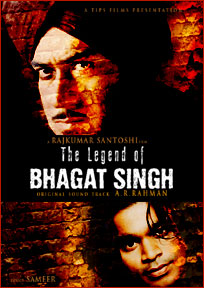 The Legend of Bhagat Singh is a very
ambitious project. The movie only has one known face, Ajay
Devgun as the title character. While most would think that casting only
one household name is a no-no, Rajkumar Santoshi
is confident that it´s all he needs. Keep in mind that in this day and age it has been
proven that an actor does not guarantee a good initial, it´s a good movie and good music
which brings people to the cinema halls. So for the soundtrack Rajkumar Santoshi roped in
the selective A R Rahman to compose the
songs. Like Zubeidaa, 1947 Earth
and Bombay; Rahman´s music was composed keeping the story in
mind. He doesn´t create any chart topping hits or hip swinging ditties here, it´s just
simple songs which help propel the story forward. If you´re expecting a masterpiece, well
this isn´t it. The soundtrack is a great effort, it has some beautiful numbers which will
appeal to very few, but it isn´t perfect. Rahman´s signature sound is written all over the
album, and 80f the soundtrack is patriotic, which won´t really appeal to a wide
audience. This isn´t his best work, however he puts in a great effort.
The Legend of Bhagat Singh is a very
ambitious project. The movie only has one known face, Ajay
Devgun as the title character. While most would think that casting only
one household name is a no-no, Rajkumar Santoshi
is confident that it´s all he needs. Keep in mind that in this day and age it has been
proven that an actor does not guarantee a good initial, it´s a good movie and good music
which brings people to the cinema halls. So for the soundtrack Rajkumar Santoshi roped in
the selective A R Rahman to compose the
songs. Like Zubeidaa, 1947 Earth
and Bombay; Rahman´s music was composed keeping the story in
mind. He doesn´t create any chart topping hits or hip swinging ditties here, it´s just
simple songs which help propel the story forward. If you´re expecting a masterpiece, well
this isn´t it. The soundtrack is a great effort, it has some beautiful numbers which will
appeal to very few, but it isn´t perfect. Rahman´s signature sound is written all over the
album, and 80f the soundtrack is patriotic, which won´t really appeal to a wide
audience. This isn´t his best work, however he puts in a great effort.