
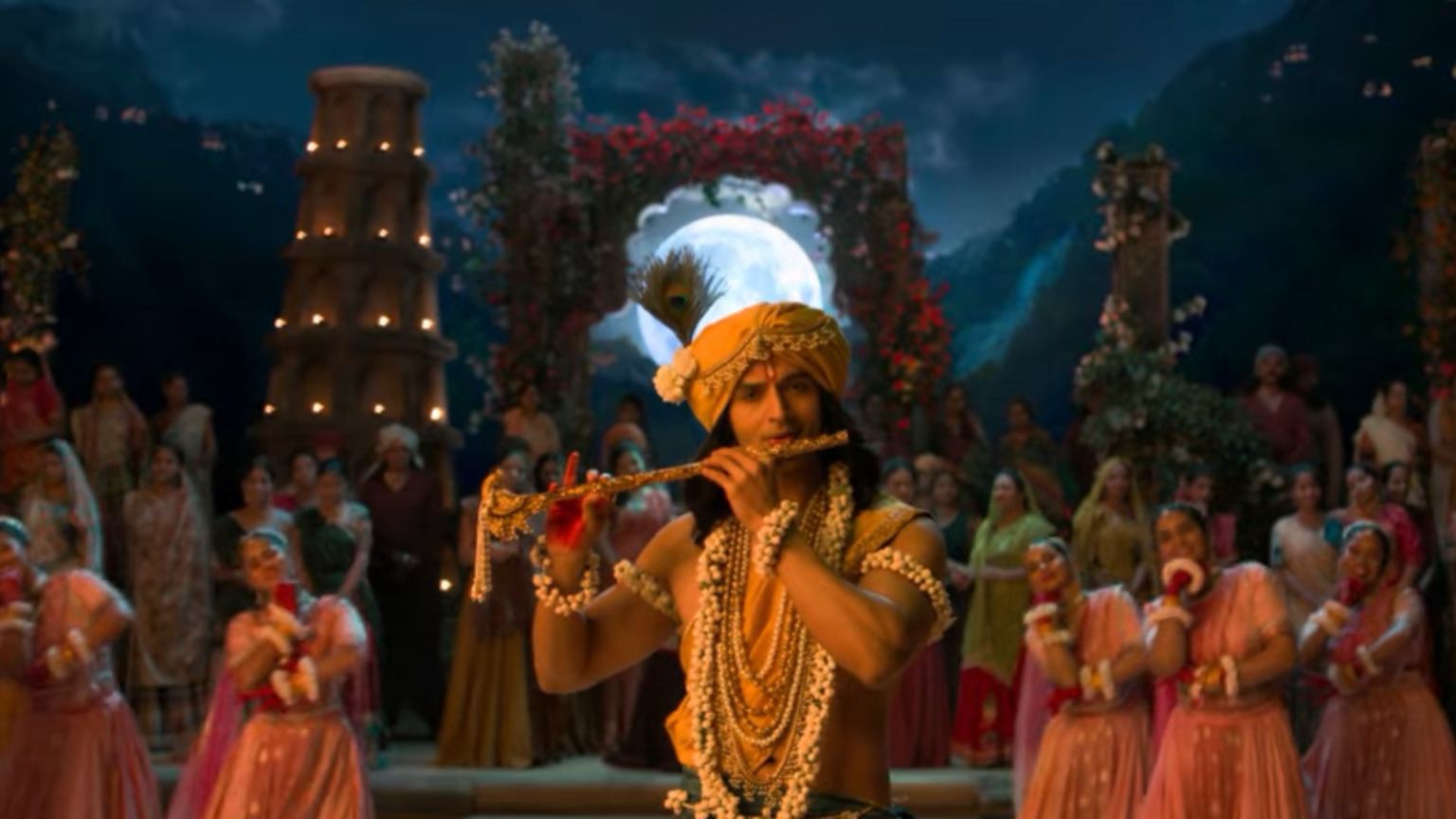
‘Krishnavataram Part 1: The Heart (Hridayam)’, directed by Hardik Gajjar, is a devotional drama that sheds light on the love between Lord Krishna and Radha. It also gives an account of the journey undertaken by Krishna from Dwarka to Kurukshetra after leaving Radha behind. Given the nature of the film, one expects songs steeped in devotion. The album features eight songs, all of which are composed by Prasad Sashte/Prasad S and written by Irshad Kamil.
The album opens with “Kunj Bihari”, a track which has designed as a bhajan. Apart from composing and producing the song, Prasad S also sings it. Prasad’s voice has a certain warmth which works very well for this song. The entire song, especially the chants, have a calming effect on one’s senses. If promoted well, this is the kind of song that could end up playing in temples and other places of religious significance in the country.
With “Prem Ki Leela” arriving next, one realizes the album would have a few songs dedicated to the bond Krishna and Radha shared with each other. “Koi dori kheenche mori, chaloon jaise aandhi, piya ji ne more seene aisi dori baandhi, Itt-utt dole jiya, ang-ang baag kiya, Bas mein nahi main aaj, re”, the lyrics written by Irshad Kamil set the tone for the song. Though his beautifully penned verses, Irshad conveys the kind of emotions Radha has in her heart for Krishna. Shreya Ghoshal did a fabulous job with the vocals. Suvarna Tiwari announces her arrival at the 3:02 mark and the song goes in another, interesting direction at this point. Javed Ali, who makes an entry almost two minutes after the song starts, renders lines written for Krishna. Given how well Shreya and Javed complement each other’s voices, it is unfortunate that one does not see them being paired opposite each other in songs enough.
The opening lines of “Shyamal Sanware”, sung by choral vocalists, are filled with a lot of energy and gives one an inkling of the kind of song one should look forward to. Sonu Nigam is exceptional as the male lead vocalist and renders the lines written by Irshad with a certain amount of reverence. While his singing has a certain ‘thehraav’ to it, Neeti brings in some vivacious energy to the song. The choral vocalists deserve special mention for their contribution. Prasad composes a highly infectious tune and layers it with a plethora of Indian instruments in sync with each other.
Shweta Mohan, one of the leading voices in Tamil cinema, made her debut in Hindi cinema with “Yun Hi Re” (‘David’, 2013). In the last few years, however, one has seen her singing sporadically (mostly dubbed Hindi films) for Hindi films. Here, Prasad utilizes her voice very well in two songs. The first one to arrive is “Mukhda Dikha Jaiyo”. The song, which talks about Radha’s longing for Kanha/Krishna, has been composed very well. The Antara, in particular, sounds very sweet. Irshad’s lyrics are splendid.
As you listen to “Mann Ki Dasha”, a solo number rendered by Shreya Ghoshal, different visuals of films made by Sanjay Leela Bhansali start floating in your mind. The reason behind it is the haunting feel in the song which comes across in many of the songs in Bhansali’s films. The operatic feel in the song could be another reason. Shreya Ghoshal sings the song with a certain tenderness which make you take notice of it immediately.
The sound of traditional strings and nadaswaram mark the arrival of “Shubh Din Aayo”, a song which is about new beginnings and celebration. The tune, composed by Prasad, has a sense of divinity to it. The composer also manages to ensure the song sounds very catchy. The hook line, in particular, is very catchy. He also arranges/ produces the song extremely well. He also uses the three lead vocalists, Shweta Mohan, Shivam Singh and Abby V, very well.
“Krishna Govinda”, to put it simply, is a song that celebrates Lord Krishna’s valour. “Jagat ka Adhikari param param upkaari, mor pankh mukutdhari sakal karam bandhe, nayan-nayan bhor-bhor maakhan ka chor-chor, chitrana ore-chor natvar naache naache, natvar naache re naache naache”, the lines written by Irshad serve as a beautiful representation of the various qualities Krishna imbibes and His devotees are inspired by. The high-on-energy celebratory number benefits greatly from Sunidhi Chauhan’s gumptious rendition. The percussion instruments contribute further towards amplifying the energy in the song.
The albums ends on a melancholic tune with the beautifully composed and written “Anth Mein Aarambh”. The song is expected to arrive at a very intense moment in the film. The song has a touch of divinity which is greatly augmented by Sonu Nigam’s soulful singing. The chants of “Hare Ram, Hare Krishna” have been interspersed very well in the song. Prasad composes a highly evocative tune that has several layers to it. “Naa soch” The song goes on a dramatic high as Sonu renders these lines written by Irshad.
In the Hindi film industry, Prasad Sashte/Prasad S is primarily known for his work as a music producer, programmer and arranger. While he did give a good account of himself as a composer in some films made in the last few years like ‘Mulk’ (2018), ‘Atithi Bhooto Bhava’ (2022) and ‘Amar Prem Ki Amar Kahaani’ (2024), this is the film where he truly comes on his own delivers an album that would garner a lot of respect and love. Irshad Kamil’s lyrics, without a doubt, play an important role in making the songs stand out. With the songs turning out to be extremely impressive, one now looks forward to see how they are picturized in the film.