
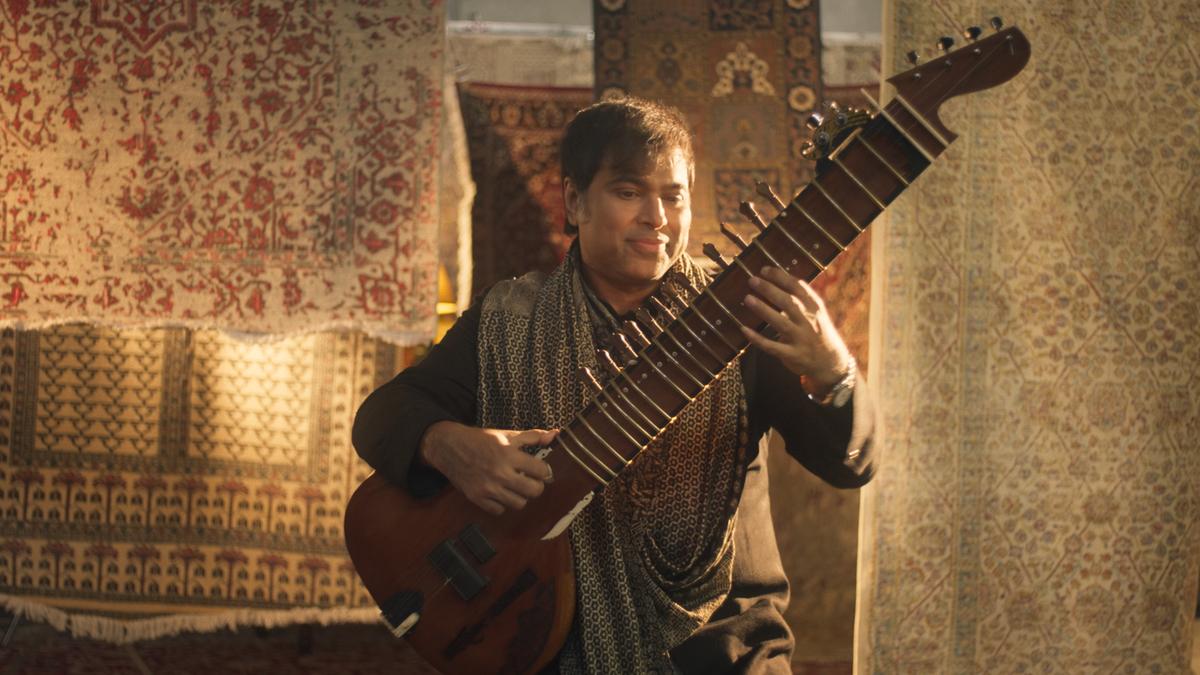
Hailing from the Senia Maihar Gharana, Purbayan Chatterjee was conditioned to be mindful of the sanctity of Indian classical music and adhere to traditions while playing the sitar. While Purbayan did that for the longest time, he also realized experimentations and collaborations play a key role in the growth of a musician. Over the years, the sitar maestro has collaborated with several notable artists including Ustad Zakir Hussain, Bela Fleck, Pat Metheny and Jordan Rudess, among others.
In this interview, Purbayan talks about training Farhan Akhtar for ‘The Beatles’ film, collaborating with guitarist Mark Lettieri on the album ‘Feathered Creatures’, the recently concluded ‘Saath Saath India’ Tour, admiration for father Parthapratim Chatterjee and the younger generation’s interest in Indian classical music.
How has been the experience of training Farhan Akhtar for the film on ‘The Beatles’ where he plays Ravi Shankar?
Training Farhan for ‘The Beatles’ film was genuinely refreshing because he approached music with immense sincerity rather than star entitlement. What impressed me most was his willingness to repeatedly unlearn and rebuild physical habits to make the sitar feel authentic on screen. I remember telling him that Indian classical music cannot merely be “acted”; the body language itself has to breathe differently. We spent a lot of time understanding not just finger positions, but the emotional stillness required while holding the instrument. Farhan is already a musician at heart, so rhythm and phrasing came naturally to him. What I appreciated most was his patience with detail, sometimes spending hours just perfecting how a meend should visually flow. For me, it became less about coaching an actor and more about sharing the philosophy behind the instrument.
You met guitarist Mark Lettieri backstage before a show you were doing with Snarky Puppy. You recently released an album, ‘Feathered Creatures’, with him. How was it collaborating with him on this album?
The beautiful thing about meeting Mark was how organic everything felt from day one. We first connected backstage after a Snarky Puppy concert, and within minutes we were speaking less like strangers and more like musicians finishing each other’s sentences. What struck me immediately was his complete absence of musical ego despite being one of the world’s finest guitarists. ‘Feathered Creatures’ grew from conversations, jams, late-night exchanges of riffs across continents, and eventually into a deeply emotional body of work. Songs like ‘9000 Miles’ literally reflect the distance between Mumbai and Fort Worth, yet musically they erase geography altogether. There are moments where the sitar behaves rhythmically like a guitar, and moments where Mark’s guitar almost sings like a raga vocalist. It never felt like “fusion” in the calculated sense, it felt like two worlds trusting each other enough to become one sound.
Is it a challenge adjusting or adapting to the style of another musician who comes from a different discipline of music?
I actually enjoy that challenge because it forces you to listen more deeply rather than simply perform. Indian classical music trains you to develop a very strong individual voice, but collaboration teaches humility. When I worked with artists like Zakir Hussain, Jordan Rudess, or Mark Lettieri, I realised the most important thing is not technical adaptation, it is emotional adaptation. For instance, in jazz or progressive music, the groove often dictates movement, whereas in raga music, emotion and melodic gravity lead the journey. Initially those worlds can seem very different, but eventually you discover they are searching for the same truth. I never try to dilute the grammar of Indian classical music; instead I try to discover where its spirit naturally overlaps with another language. That space of tension and trust is where the magic usually happens.
You recently concluded the ‘Saath Saath India’ Tour. How was that experience like?
The ‘Saath Saath India’ Tour was very special to me because it celebrated companionship through music, between artists, traditions, and audiences. India has such diverse listening cultures, and every city responds differently to the same raga or groove. One thing I have always loved is that Indian audiences can move seamlessly from silence during an alaap to explosive energy during rhythmic exchanges. I still remember performing at Sawai Gandharva years ago after Pandit Bhimsen Joshi himself invited me, and feeling the sheer weight of that musical legacy. Experiences like that shaped how I approach touring even today. With ‘Saath Saath’, I want listeners to experience Indian classical music not as something distant or intimidating, but as something emotionally immediate and contemporary. Every concert becomes a conversation rather than a recital.
You learnt to play the sitar from your father, Parthapratim Chatterjee. What is that one quality in him that you admire the most?
The quality I admire most in my father is dignity in the face of struggle. He taught me that music is not a shortcut to recognition, it is a lifelong discipline that demands honesty even when nobody is applauding you. Growing up, I saw him remain deeply committed to the purity of music despite not always receiving the institutional visibility that others did. One incident I can never forget was during my childhood in Kolkata, when I was made to sit far behind at a concert gathering because the organisers recognised only musicians from famous lineages and their children. That moment stayed with me for years, not as bitterness, but as fuel. My father never reacted with anger; he simply told me to let my music speak over time. Perhaps that is why I later founded PAAMF, to create doors for talented students who may not come from privilege or legacy.
What are your thoughts on the younger generation’s interest in Indian classical music? Do you see a growth in interest?
Absolutely, I actually think we are witnessing a fascinating resurgence, though it looks very different from earlier generations. Young listeners today may first discover a raga through Instagram, a film soundtrack, or a collaboration with electronic or jazz artists, and I think that is perfectly valid. The gateway has changed, but the emotional impact of the music remains timeless. I see this constantly during concerts, young audiences are incredibly curious when they are not made to feel excluded by excessive rigidity. Technology and social media have democratised discovery in a powerful way. At the same time, I feel, we as musicians have a responsibility to present classical music with honesty while also making it culturally relevant to contemporary life. If we preserve the soul while evolving the language, Indian classical music has the power to reach a truly global generation.