
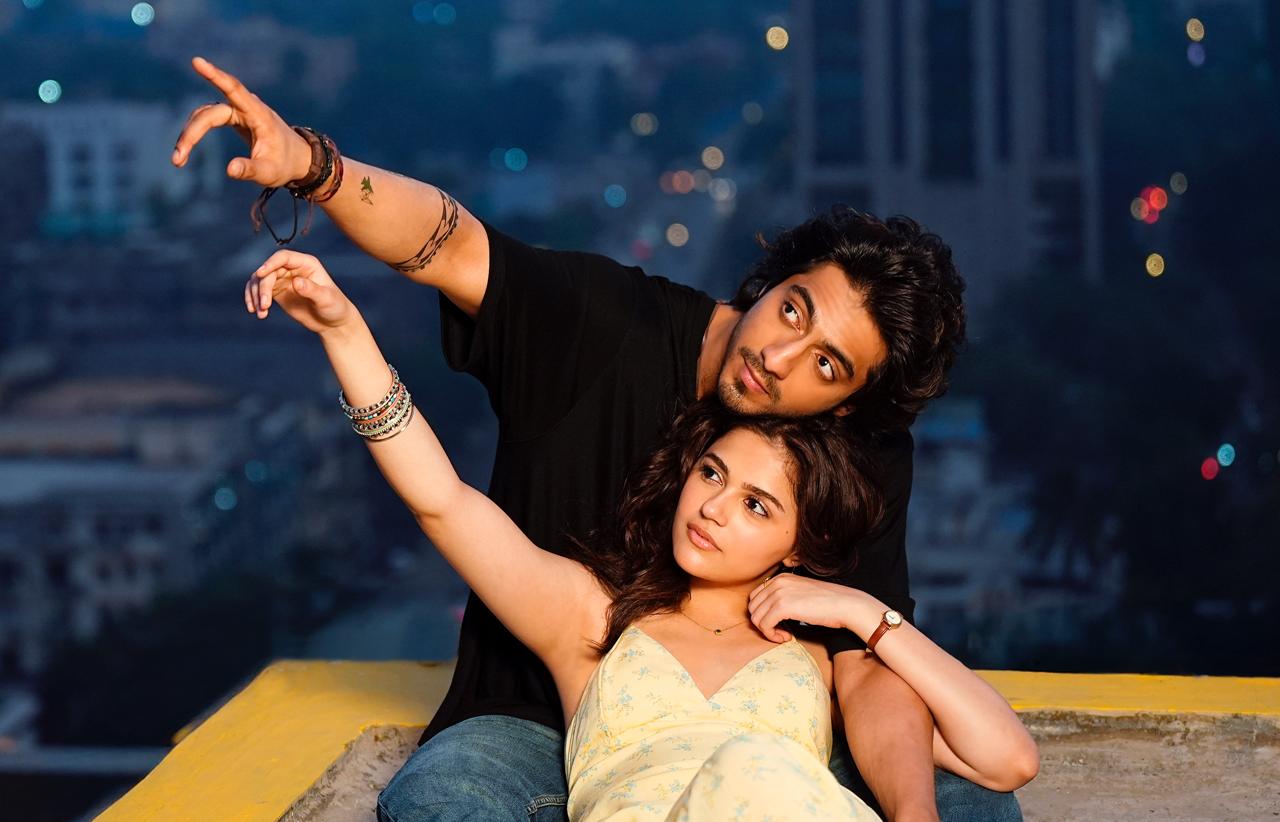
Whenever a young love story, featuring fresh faces in the lead roles, arrives, one has good expectations from its music. While it does not happen very frequently now, there was a time when producers and directors would put in a great amount of effort to ensure the music of a film, which is riding on newcomers, turns out to be special. ‘Saiyaara’, produced by Yash Raj Films, features Aneet Padda and Ahaan Panday in the lead roles. While Aneet has already proved her mettle as an actor with her performance in the film ‘Salaam Venky’ and the streaming show ‘Big Girls Don’t Cry’, the film is Ahaan’s very first project as an actor.
‘Saiyaara’ happens to be the first collaboration between YRF and director Mohit Suri. As is the case with most of his films, Mohit opts for multiple composers and lyricists for this romantic musical drama as well. The album features seven tracks, out of which two happen to be ‘reprise’ versions. The composers on the album are Mithoon, Sachet-Parampara, Rishabh Kant, Vishal Mishra, Tanishk Bagchi, Faheem Abdullah and Arslan Nizami. The lyrics have been penned by Irshad Kamil, Raj Shekhar, Prashant Pandey, Mithoon and Rishabh Kant.
The album opens with “Saiyaara”, the title track composed by Tanishk Bagchi, Faheem Abdullah and Arslan Nizami and written by Irsha Kamil. Faheem, who has been credited as one of the composers on the song, also sings it. In today’s times, many people working in the film and music industry operate with the (false) assumption that attention spans are decreasing. Therefore, a large number of songs churned out these days tend to be quite short. Kudos to Mohit Suri for giving Tanishk, Faheem, Arslan and Irshad the opportunity to put together a song that six minutes and eleven seconds long.
“Saiyaara” is a very intense song. Everybody credited on the song contributes towards bringing the intensity to the fore optimally. While the song might remind one of many of the Pakistani pop songs which became popular in the mid-2000s, it manages to build a distinctive identity for itself. At the 4:21 mark, when you feel the track has come to an end, you suddenly hear Faheem’s voice again and the melody goes on another high altogether.
When this song was being created, Mohit, perhaps, got reminded of the female version of “Sun Raha Hai Na” from his film 2013 film ‘Aashiqui 2’. While asking the composers to put together a reprise version of “Saiyaara”, his brief, perhaps, was to recreate the feel of that song. In today’s times, when barely gets to hear Indian instruments prominently in Hindi songs, it is wonderful to see a song being led by a tabla-dholak arrangement.
“Barbaad”, the second song on the album, too, has a lot of intensity. It also has a dreamy vibe to it which complements Jubin Nautiyal’s vocals very well. Going by the lyrics, the song arrives at a time Krish (Ahaaan Panday) starts falling in love with Vaani (Aneet Padda). The tune, composed by Rishabh Kant or The Rish, is free-flowing and gets registered in your mind as soon as you hear it for the first time. While the song is largely driven by the sound of electronic beats, synthesizers, electric guitar, some of the instruments heard sporadically (sarangi, electric saaz) add a lot of value to the song as well. The reprise version of the song, rendered by Shilpa, is scintillating to say the least. The song, however, is just 2 minutes and 10 seconds long. One wishes it was longer.
Next arrives “Tum Ho Toh”, the best song on the album. The video of the song, released a while back, shows the lead couple enjoying themselves on a day off. “Tum mile in dardon mein raahat ban ke, tum mile ik sufi ki chahat ban ke”, the lyrics written by Raj Shekhar encapsulate the emotions of two young individuals who are experience the joy of falling in love and enjoying each other’s company. Vishal Mishra, on his part, creates a beautiful tune that gives a sense of joie de vivre. He does very well as a vocalist too.
The song hits a high as Hansika Pareek announces her arrival at the 3:23 mark and renders the lines “Hum, hum na jaane kab aise hanse thhe”. Her voice has a certain innocence which works wonders for the song and the character played by Aneet. While the song works as a whole, the parts composed by Vishal for Hansika are extremely melodious. This is the kind of song you would want to hear on a loop while being out on a long drive with your loved ones.
Over the years, Sachet – Parampara have created songs of different genres and offered sufficient evidence of the fact that they are extremely versatile as music composers. However, for some reason, a lot of filmmakers keep calling them to create rock ballads. They have, of course, delivered a plethora of hits in this space including ‘Bekhyali’ (‘Kabir Singh’) and ‘Mehram’ (‘Jersey’).
“Meri befiqri ki fiqar tu, meri saanson ka hai zikar tu, hum humqadam se hamraah hue, ab hamraah se hamnava huye”, the lines written by Prashant Pandey set the tone for “Humsafar”. Prashant is credited as a intro ad-lib lyrics here. The rest of the song is written by Irshad Kamil. As one can see in the video, the song is a culmination of the two lead characters jamming and coming up with a song. The tune composed by Sachet-Parampara is highly addictive. My favourite bit in the song is the part where Parampara sings “”. Along with Sachet-Parampara, the track has been produced by Nikhil-Swapnil, Swapnil Tare, Vaibhav Pani and Raghav Sharma who create a nice concoction of sound using multiple instruments.
The last original track on the album is “Dhun”, written and composed by Mithoon, somebody whom Suri frequently collaborates with. The song grows on you as you keep listening to it. Arijit Singh elevates the song considerably through his heartfelt rendition. There are, however, some issues with the song. The tune is nice but gives a sense of déjà vu. You get reminded of several other such songs composed by Mithoon in the past. While the thought driving “Dhun” is good, the awkwardly written lyrics cost the song heavily.
As a director, Mohit Suri is known for making film that boast of popular music. While some of his films have had albums wherein every song became a hit, there have been films which boasted of a handful of hit songs with the rest getting unnoticed. ‘Saiyaara’ turns out to be the best album for a Mohit Suri film in years. With the songs being promoted extensively weeks before the film’s release, one expects the entire album to rise up the popularity charts with time.